What is a greenhouse growing medium?
A growing medium is the physical environment that anchors roots and regulates the movement of water, air and dissolved nutrients. It may be amended field soil, a container blend, a grow-bag substrate or a granular medium. Fertility alone does not make a medium effective. A nutrient-rich blend can still fail if it compacts, remains saturated, dries unevenly or becomes difficult to rewet.
Hot climates amplify these risks. Long irrigation events may displace air from the pore system, while an excessively coarse medium in a shallow container can dry too quickly. Medium design therefore has to be evaluated together with root depth, dripper discharge, irrigation frequency, temperature and water chemistry.
Seven selection criteria
- Post-drainage air: roots require oxygen after free water exits.
- Plant-available water: retained water must remain accessible without prolonged saturation.
- Uniform drainage: the profile should not develop persistently wet and dry pockets.
- Structural stability: the blend should resist rapid settling, shrinkage and compaction.
- Rewetting behavior: test how evenly the medium rewets after partial drying.
- Water and fertilizer compatibility: monitor irrigation and leachate pH and EC.
- Supply consistency: commercial operations need repeatable particle distribution and handling.
How particle size changes performance
Finer particles generally increase water retention but can reduce large air pores when used excessively. Coarser particles usually increase macroporosity and drainage, but may accelerate drying, especially in shallow containers. There is no universally superior grade; performance is defined by the complete system.
| Operating condition | Primary need | Likely direction |
|---|---|---|
| Grow bags or beds needing structural support | Moisture moderation with drainage | A finer grade such as 0–4 mm within a tested blend |
| Medium-depth pots and planters | Balanced air and water | A medium grade such as 4–8 mm |
| Granular systems or very fast drainage | High air space and particle stability | A washed coarse grade such as 10–25 mm |
| Drying-sensitive crop in a shallow container | Avoid excessive drainage | Reduce coarse fraction and refine irrigation frequency |
The role of agricultural volcanic tuff
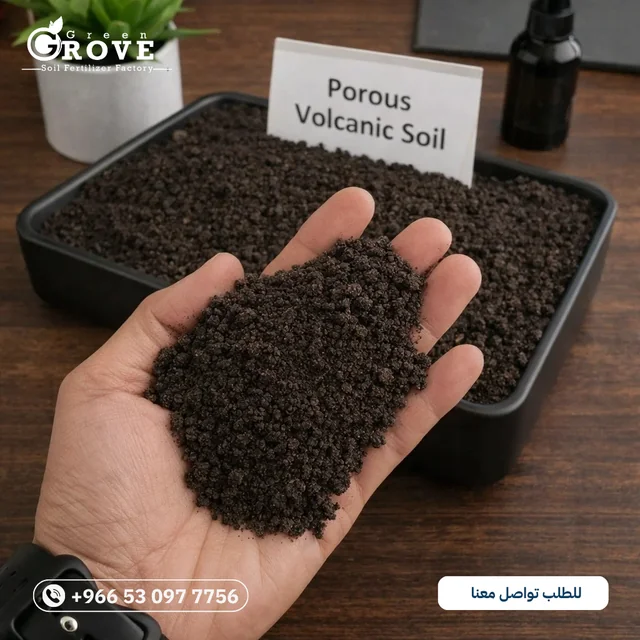
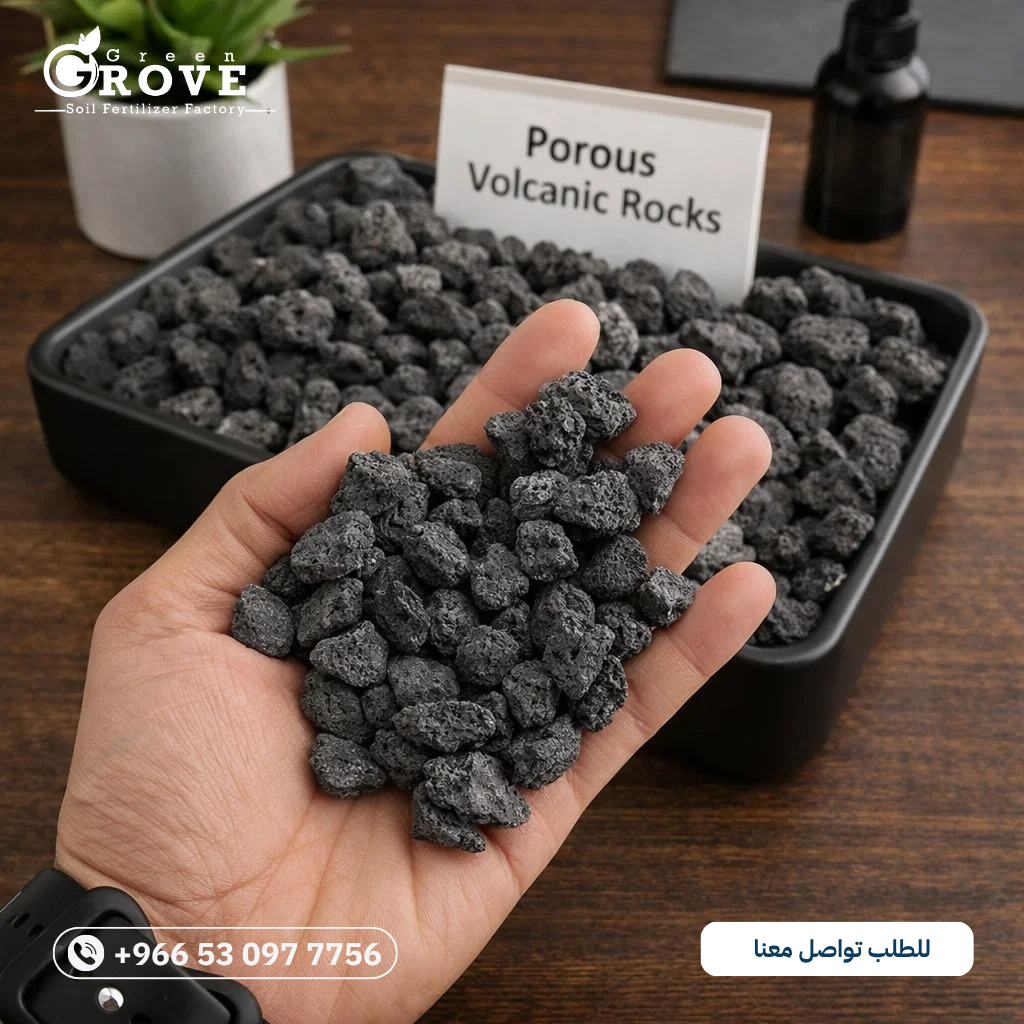
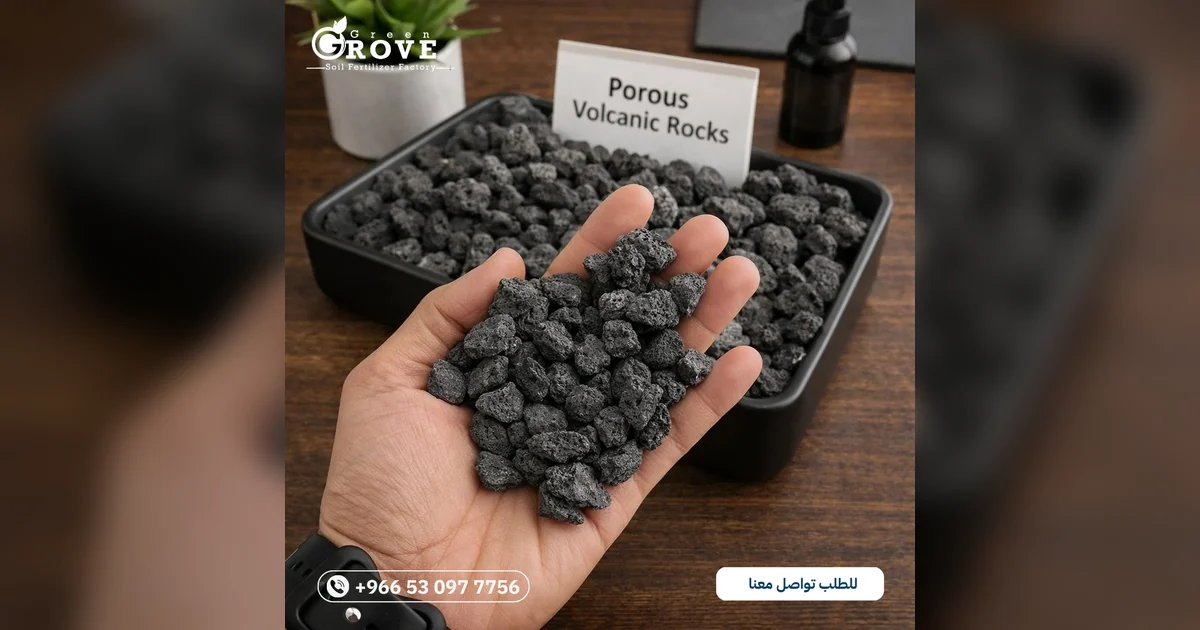
Agricultural volcanic tuff is a porous mineral component used to engineer physical conditions around roots. It is not a complete fertilizer. Green Grove Soil, produced in Madinah, Saudi Arabia, is available in 0–4 mm, 4–8 mm and 10–25 mm functional grades. The finer grade supports medium building and moisture moderation; the medium grade balances air and drainage; the coarse grade supports high-aeration and granular applications.
Blend percentages should be calculated by volume and verified locally. Crop, organic component, container geometry, water chemistry and irrigation scheduling all change the appropriate ratio. Fine material may be lightly moistened when dust is present, while coarse material should be thoroughly washed before hydroponic or aquaponic use.
Trial protocol before commercial adoption
- Select representative plants of the same crop, age and container.
- Compare the current medium with no more than two controlled alternatives.
- Use production-equivalent drippers and flow rates.
- Record irrigation volume, time to first drainage and leachate percentage.
- Measure irrigation-water and leachate pH and EC consistently.
- Inspect roots for color, distribution, odor and dead zones.
- Choose the blend that produces stable, manageable performance rather than a one-day visual result.