Green Grove Soil Factory logo
Green Grove Soil Factory
"Together, let’s make it greener"
AR
Home/Green Grove Soil 4–8 mm
Medium grade | Balanced aeration, drainage & structural stability

Green Grove Soil 4–8 mm

A medium-grade, highly porous agricultural volcanic tuff designed to balance aeration, drainage, moderate moisture retention, and structural stability in granular systems, aquaponics, medium-to-coarse growing mixes, pots, and long-life surface dressing.

Request a quote
Retail price: SAR 17 / bag In stock Wholesale pricing by volume Weight: 10 kg Approx. bulk density: 0.7 g/cm³

The price shown is the retail price. Large-volume pricing varies by order size, packaging type, and destination.

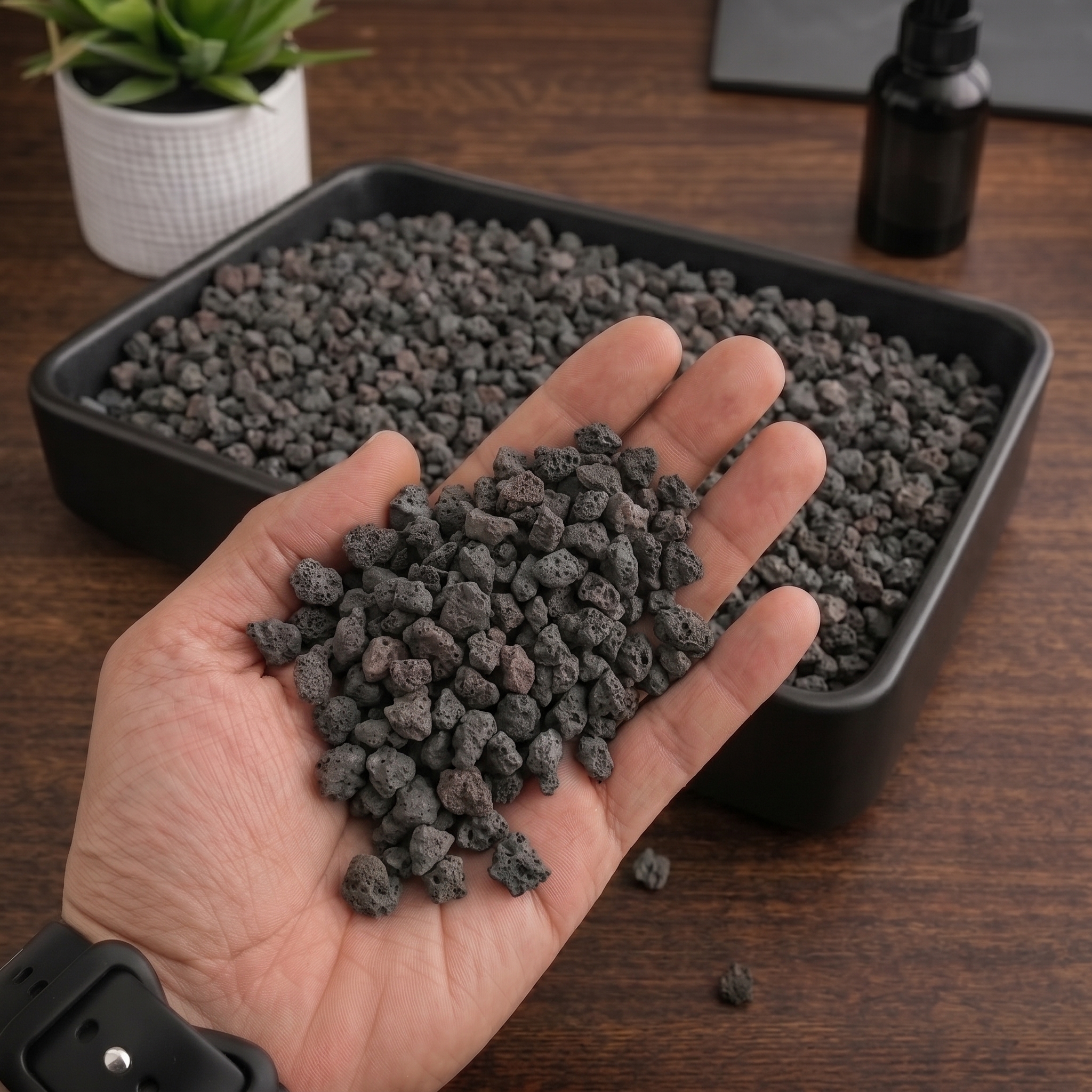
Green Grove Soil agricultural volcanic tuff 4–8 mm
Technical positioning for this size: balanced aeration and drainage with moderate moisture retention and stable growing-medium structure around the root zone.

Core technical specifications

pH ≈ 7.0 Moisture below 0.6% Dry matter 99.4% 0.7 g/cm³ Retail price SAR 17 Availability: In stock

This grade is a balanced option when good aeration, regular drainage, particle stability, and durable granular applications are required.

Technical reading

  • A medium-grained volcanic medium with balanced aeration, intended for granular hydroponic systems, aquaponics, medium-to-coarse mixes for air-demanding plants, and long-life functional and decorative top dressing. It provides structural stability, reliable drainage, reusability, and an air-rich root environment without shifting the medium toward unnecessarily rapid drying.

Where does this size excel?

  • When a practical balance is needed between root-zone air, drainage, and moderate moisture retention.
  • In granular media beds, individual irrigated containers, aquaponics, and some vertical granular systems.
  • In coarse mixes for succulents, cacti, bonsai, and orchids.
  • In surface dressing that combines decorative value, reduced evaporation, and long service life.

Technical limits

  • If used alone with long irrigation intervals, the available water reserve may become too low for some crops.
  • It is not suitable for germination trays or small plug cells.
  • It is not a primary drainage solution simply by placing it as a separate bottom layer in pots; real improvement comes from the composition of the entire medium.
  • Full use in granular media requires thorough washing and confirmation that particle distribution matches the system design.

Recommended use windows

All ratios are volumetric, not by weight. These are practical operating windows that can be adjusted according to crop, irrigation program, and water quality.

Application Recommended window Technical reading
Granular-media hydroponics 100% 4–8 mm after thorough washing Works well with short, frequent irrigation cycles and ongoing monitoring of water and leachate quality.
Aquaponics 100% washed 4–8 mm An operating depth of roughly 25–30 cm is preferred in granular beds for most crops.
Increasing aeration within mixes 15–30% in general mixes, with higher ratios in very humid environments or drought-tolerant crops Blend it through the full volume rather than placing it as a separate bottom layer.
Succulent, bonsai, and cactus mixes 40–70% depending on plant type and the base mix used The greater the need for drainage and air, the higher the ratio can be raised.
Orchid mixes 30–60% with bark or other suitable coarse components Improves root-zone air and helps prevent prolonged saturation.
Surface dressing Layer thickness 5–7.5 cm, and up to 10 cm in very dry sites Leave a clear collar around the stem or trunk and avoid direct contact with the plant base.
Basal layer in deep containers 1–2 cm only when needed to protect drain holes or add weight and stability A practical use case only when the full medium has been designed correctly.

Use by cultivation system

Size selection remains tied to system design, medium depth, and irrigation or flood frequency.

Granular beds and recirculating systems

4–8 mm excels when the goal is a well-aerated, free-draining medium with a rough, porous surface that supports biofilms in granular beds.

Aquaponics

This size serves aquaponics well after thorough washing, but performance depends not only on the raw material; bed design, flow pattern, and fine-particle control also matter.

Deep pots and medium-to-coarse mixes

Use it through the full medium volume to increase air and structure; placing it as a separate bottom layer is not the correct route to improve drainage.

Surface dressing and landscape use

This is one of the product’s strongest placements because it combines long service life, reduced evaporation, and an improved site appearance.

Use by crop

Condensed placements derived from the comprehensive technical guide and the approved mixing windows.

Strawberry

4–8 mm can be used as a full medium under very high irrigation control, or at roughly 20–30% within an organic base, because strawberry needs an aerated medium that does not dry too quickly.

Succulents, cacti, and bonsai

This segment is one of the best uses for the medium grade, with the ratio rising to 40–70% depending on plant type and the base mix used.

Orchids

Use at 30–60% with bark or other suitable coarse materials, improving root-zone aeration and reducing long periods of saturation.

Palms and trees

It is often used as a 5–7.5 cm surface dressing when needed, while the real technical work remains focused on improving the medium within the active rooting depth.

Operating controls and reuse

  • Thorough washing before hydroponic and aquaponic systems is essential, not optional.
  • The coarser the medium and the shallower the container, the greater the need for shorter and more frequent irrigation.
  • Confirm particle-size distribution against the system design before full commercial operation.
  • Real drainage improvement occurs through the full medium volume, not from a separate bottom layer alone.
  • 4–8 mm can be reused after removing roots and residues, followed by thorough washing and sanitization when needed.
  • This reusability is an important economic advantage in commercial projects and recirculating systems.

Technical validation center

Core validation files, technical cards, and operating documents.

Primary reference

Comprehensive technical guide

The comprehensive technical reference for the available grades.

View
Technical support

FAQ bank

Key frequently asked questions.

View
Brief file

Technical data sheet TDS

Technical data for the available grades.

View
Product card

0–4 mm card

Identity and use windows for the fine grade.

View
Product card

4–8 mm card

Identity and core uses for the medium grade.

View
Product card

10–25 mm card

Identity and use windows for the coarse grade.

View
Lab analysis

Physical and chemical analysis

Reference for the approved core properties.

View
Official certification

Organic input certificate

Organic input document.

View
Official certification

Registration certificate

Dedicated link to official registration data.

View
Safety

SDS certificate

Visual referenceSafety handling, and storage.

View
Facility reference

Commercial registration

Supplier and producer verification document.

View

Common technical questions

Can 4–8 mm be used on its own?

It can be used on its own in selected granular media and controlled-irrigation applications after thorough washing and testing, while monitoring drying rate, water quality, and drainage. It does not replace an appropriate crop nutrition program.

Is it enough to place it only at the bottom of the pot?

No. Real drainage improvement comes from the composition of the entire medium; a bottom layer is limited to protecting drain holes or adding weight and stability when needed.

Is it suitable for succulents and orchids?

It is suitable for succulent, cactus, and bonsai mixes when the ratio and irrigation are controlled. For orchids, suitability depends on root size and bark type, so testing it at a limited proportion in the mix is recommended.

Can it be reused?

It can be reused after removing roots and residues, followed by thorough washing and sanitization when needed between cycles.

Request a precise application recommendation for this grade

Share the crop type, cultivation system, medium depth, and irrigation program, and we will guide you to the most suitable choice between the fine 0–4 mm grade, the medium 4–8 mm grade, the coarse 10–25 mm grade, or a suitable blend for the application.