Green Grove Soil Factory logo
Green Grove Soil Factory
Together, let’s make it greener.
AR
Home/Green Grove Soil 0–4 mm
Fine grade | Medium building & moisture management

Green Grove Soil 0–4 mm

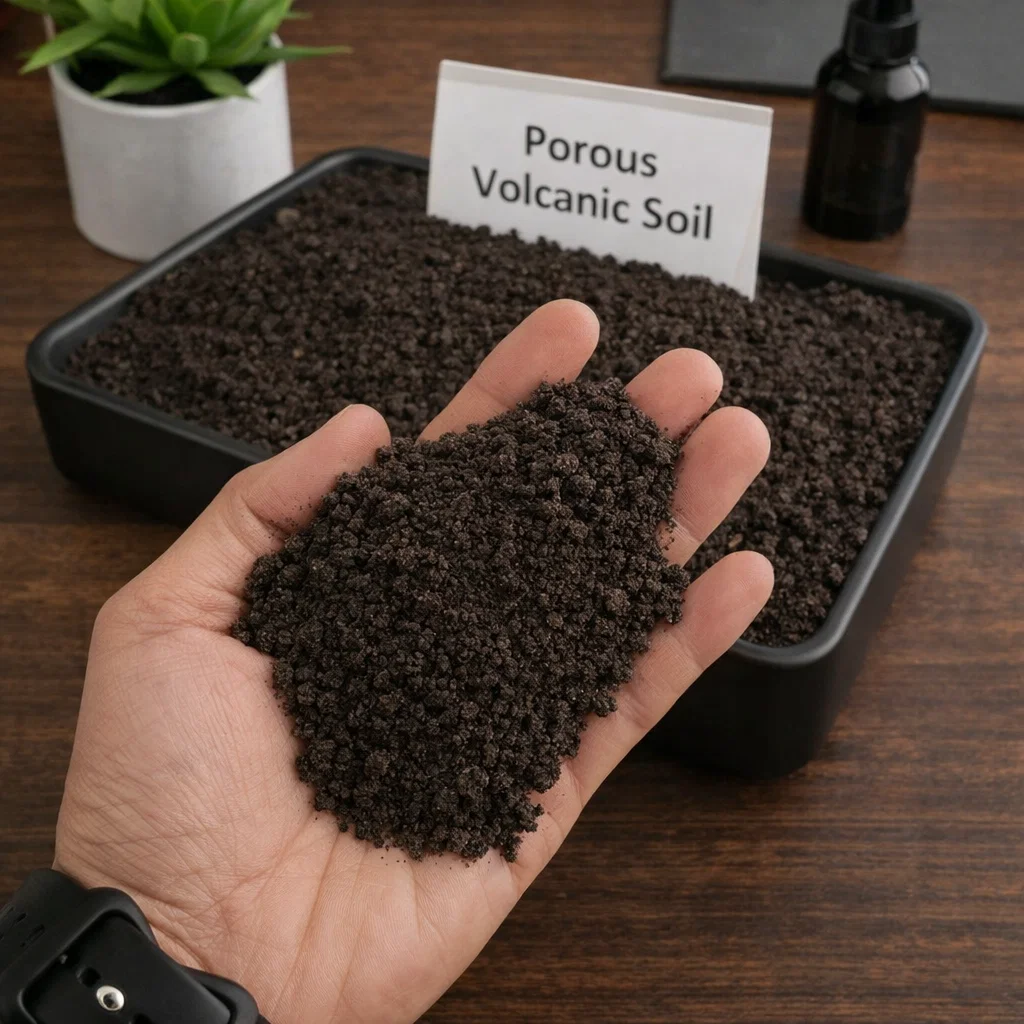
A fine-to-medium grade of highly porous agricultural volcanic tuff. Depending on the application, it may also be read as a fine agricultural volcanic soil, engineered to build the medium, increase structural stability, and improve growing mixes with controlled moisture retention in the root zone.

Request a quote
Retail price: SAR 17 / bag In stock Wholesale pricing by volume Weight: 15 kg Approx. bulk density: 0.9 g/cm³

The price shown is the retail price. Large-volume pricing varies by order size, packaging type, and destination.

Green Grove Soil agricultural volcanic tuff 0–4 mm
Technical positioning for this size: medium building, moisture management, and increased stability in growing mixes.

Core technical specifications

pH ≈ 7.0 Moisture below 0.6% Dry matter 99.4% 0.9 g/cm³ Retail price SAR 17 Availability: In stock

This grade is the primary choice when the priority is medium building and moisture management within the active root zone.

Technical reading

  • A fine volcanic mineral root-zone enhancer designed to improve soil structure and growing mixes while increasing water-management efficiency in the root zone. It supports aeration and drainage while retaining moisture in a controlled way, and gives mixes higher structural stability with less shrinkage, making it suitable for pots, greenhouses, nurseries, grow bags, and some soilless applications under precision irrigation.

Where does this size excel?

  • When the need for balanced moisture is higher than with the coarse grade while maintaining good drainage.
  • When the goal is to increase mix stability and reduce settling in light organic media.
  • When improving a compact soil or a loose root-zone mix is required.
  • When a mineral medium more stable than many fully organic media is desired.

Technical limits

  • It is not the best standalone choice for very small seedling trays or very shallow cells.
  • It should not be used as the primary filling medium in narrow hydro channels or free-root systems such as NFT and DWC.
  • If used as a full mineral medium, it requires short, frequent pulse irrigation, a controlled fertilization program, and leachate monitoring.
  • Any scale-up to a large project should be preceded by a small local trial confirming that drying speed and air fraction suit the crop.

Recommended use windows

All ratios are volumetric, not by weight. These are practical operating windows that can be adjusted according to crop, irrigation program, and water quality.

Application Recommended window Technical reading
Peat moss or cocopeat mixes 25–40% 0–4 mm + 60–75% suitable organic base An excellent window for flowers, leafy vegetables, pots, and general nursery production.
Full mineral medium in grow bags or irrigated beds 100% 0–4 mm, or 85–95% 0–4 mm + 5–15% 10–25 mm 0–4 mm should remain the base, with the coarse grade added only as an aeration correction when needed.
Blending with compost 10–20% mature compost + 20–35% 0–4 mm + the balance as a suitable base Reduce the compost proportion if it is high in salinity or not fully mature.
Seedlings and propagation trays Only 5–15% within a light propagation mix It functions as a structural enhancer, not as a sole base.
Soil amendment 5–10% by volume through a 15–20 cm depth, increasing to 10–15% in heavy soils or raised beds The benefit comes from mixing it into the active root zone, not from limited surface scattering.

Use by cultivation system

Size selection remains tied to system design, medium depth, and irrigation or flood frequency.

Grow bags and pots under drip irrigation

0–4 mm functions as a stable medium base, either alone in highly controlled systems or within a balanced organic/mineral mix under precise irrigation with leachate monitoring.

Greenhouses and soil improvement

It supports soil improvement in the active root zone and increases medium stability in light media, with clear benefits when it is truly mixed into depth.

Fine mineral systems

It can work as a near-complete medium only in highly controlled systems, with a limited amount of the coarse grade added when the application requires more air.

Vertical farming and planting pockets

It is useful when a less coarse medium with better moisture retention is needed, especially in shallow pockets and under precision irrigation.

Use by crop

Condensed placements derived from the comprehensive technical guide and the approved mixing windows.

Palms and trees

Use 0–4 mm within the wetted zone or basin by actually mixing it into depth; it improves aeration and moisture management within the basin more than surface covering alone.

Leafy vegetables and herbs

It serves this crop group very well at 25–35% within a suitable organic base, or as a near-complete fine medium in highly controlled mineral systems.

Strawberry

0–4 mm may work as a full medium under high irrigation control, or at roughly 20–30% within an organic base, because strawberry needs an aerated medium that does not dry too quickly.

Seedlings

It is recommended only at 5–15% within a light propagation mix, while the coarse grade is not used in small seedling trays.

Operating controls and reuse

  • All ratios listed are volumetric, not by weight.
  • It is preferable to moisten 0–4 mm before mixing when dust is present to improve blending and reduce airborne particles.
  • The greater the irrigation control, the safer and more effective it becomes to use a full mineral medium.
  • Monitor pH, EC, and leachate readings regularly, especially with water high in bicarbonates or salinity.
  • If 0–4 mm is used as a near-complete medium, adding 5–15% of 10–25 mm should be treated as an aeration correction tool, not a fixed rule.
  • Reuse is possible after cleaning, reconditioning, and verifying cleanliness and particle distribution before returning it to service.

Technical validation center

Core validation files, technical cards, and operating documents.

Primary reference

Comprehensive technical guide

The complete reference for both grades.

View
Technical support

FAQ bank

Key frequently asked questions.

View
Brief file

Technical data sheet TDS

Technical data for both grades.

View
Product card

0–4 mm card

Identity and use windows for the fine grade.

View
Product card

10–25 mm card

Identity and use windows for the coarse grade.

View
Lab analysis

Physical and chemical analysis

Reference for the approved core properties.

View
Official certification

Organic input certificate

Organic input document.

View
Official certification

Registration certificate

Dedicated link to official registration data.

View
Safety

SDS certificate

Reference for safety, handling, and storage.

View
Facility reference

Commercial registration

Supplier and producer verification document.

View

Common technical questions

Is 0–4 mm a complete substitute for peat moss?

It is not an absolute substitute for every application, but it works as a functional mineral component that increases stability and air while regulating moisture within the mix.

When should 10–25 mm be added with it?

When you need a modest increase in aeration within a finer medium or a mineral system that is sensitive to drying. As a rule, 0–4 mm should remain the base.

Is it suitable for small seedling trays?

Use only at 5–15% within a light propagation mix; it should not be relied upon alone as the sole medium in very small cells.

Can it be used as a complete mineral medium?

Yes, but only in some highly controlled systems, with tighter irrigation management and local testing of leachate and drying speed.

Request a precise application recommendation for this grade

Share the crop type, cultivation system, medium depth, and irrigation program, and we will guide you to the most suitable positioning between the fine grade, the coarse grade, or a blend of both.