Search for agricultural soil and you will find many products and blends, but the name alone does not tell you whether a mix is suitable. A good root-zone medium is more than brown material placed around a plant: it should hold the roots, provide usable water and nutrients, allow air to enter, and let excess water leave.
This guide explains what agricultural soil and growing media are, the main ingredients used in mixes, how to choose media for pots, gardens, nurseries, trees, and succulents, and where agricultural volcanic stone can support physical structure without being presented as a fertilizer replacement or a universal solution.
What Is Agricultural Soil?
Agricultural soil is the medium in which roots grow. It may be natural field soil, a manufactured blend of organic and mineral components, or a soilless growing medium that contains no conventional field soil. The practical goal is to create a root environment that supports the crop.
Quality is not determined by color or softness alone. Physical, chemical, and biological characteristics matter. Structure controls water and air movement and strongly influences root growth. A mix can look attractive when purchased and still compact or shrink after months of irrigation.
Characteristics of a Good Agricultural Soil or Growing Medium
- Balanced drainage that removes excess water without making the mix dry immediately.
- Adequate aeration around roots.
- Water-holding capacity appropriate to the crop and climate.
- Reasonable volume and structural stability over time.
- As free as practical from unusual odors, contaminants, and weeds.
- pH and salinity appropriate to the intended plant.
- Particle size suited to the pot, bed, or project.
- Enough physical support for roots while allowing them to spread.
Agricultural Soil vs. Growing Medium
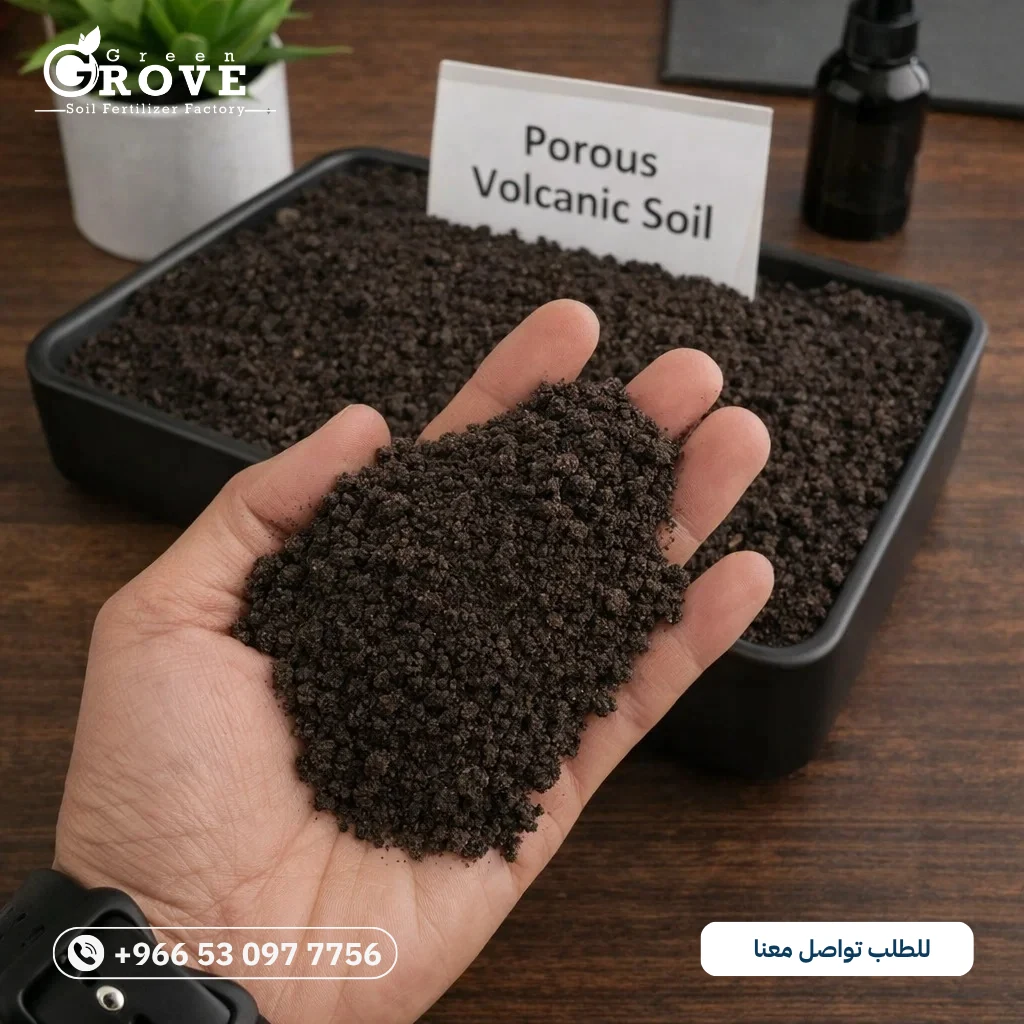
The terms are often used loosely. Agricultural soil may refer to natural soil containing sand, silt, clay, and organic matter. A growing medium can be an engineered blend of peat, cocopeat, compost, perlite, agricultural volcanic stone, or other ingredients and may contain no field soil at all. In pots and nurseries, designed substrates are often easier to manage than heavy garden soil because their structure can be controlled more precisely.
Main Components of Agricultural Growing Media
1. Organic Components
Peat moss, cocopeat, compost, and decomposed organic materials are commonly used to retain water and nutrients. Their quality, salinity, and decomposition stage vary, and some materials shrink over time.
2. Mineral Components
Sand, perlite, vermiculite, expanded clay, and agricultural volcanic stone can be used to adjust weight, porosity, drainage, aeration, and structural stability.
3. Nutrients
A commercial mix may contain starter or slow-release fertilizer, or it may contain no fertilizer at all. Do not assume that a product described as agricultural soil provides a complete nutrition program.
4. Conditioners
Some blends contain materials intended to adjust pH, water behavior, or stability. Read the specification and understand the purpose of each component rather than relying only on general marketing descriptions.
Types of Agricultural Soil and Their Typical Uses
| Type | General Characteristics | Typical Use |
|---|---|---|
| Potting mix | Relatively light; balances moisture and drainage | Indoor plants and balcony containers |
| Seedling mix | Fine, uniform, light, and well drained | Germination, cuttings, and young seedlings |
| Cactus and succulent mix | Higher mineral fraction and faster drainage | Cacti and succulents |
| Tree and planter soil | Greater structural stability for larger volumes | Trees, palms, and landscape planters |
| Garden soil | Often includes natural soil and organic matter | Ground beds and gardens |
| Soilless growing medium | Engineered organic and mineral components | Nurseries, protected cultivation, and selected production systems |
How to Choose the Right Agricultural Soil
Start With the Plant
Plants do not need the same mix. Cacti require faster drainage than many foliage plants, while seedlings need smaller and more uniform particles than large trees.
Consider the Growing Location
A small pot dries faster than a ground bed, and a pot without effective drainage behaves very differently from a well-drained container. Heat and wind in Saudi Arabia can accelerate water loss, so aeration must be balanced with sufficient usable moisture.
Check the Ingredients
Do not stop at “ready-mix soil.” Review the components and, where relevant, ask about particle size, salinity, pH, density, and recommended use.
Test Drainage
Place a sample in a container with functional drainage and irrigate slowly. The medium should wet reasonably evenly and allow excess water to leave without prolonged ponding or simply bypassing the mix along the pot wall.
Monitor Structural Stability
A good mix should not quickly turn into a dense mass or lose a large fraction of its volume after a few irrigation cycles. Consistency is especially important in nurseries and projects where repeatable performance is required.
Role of Agricultural Volcanic Stone
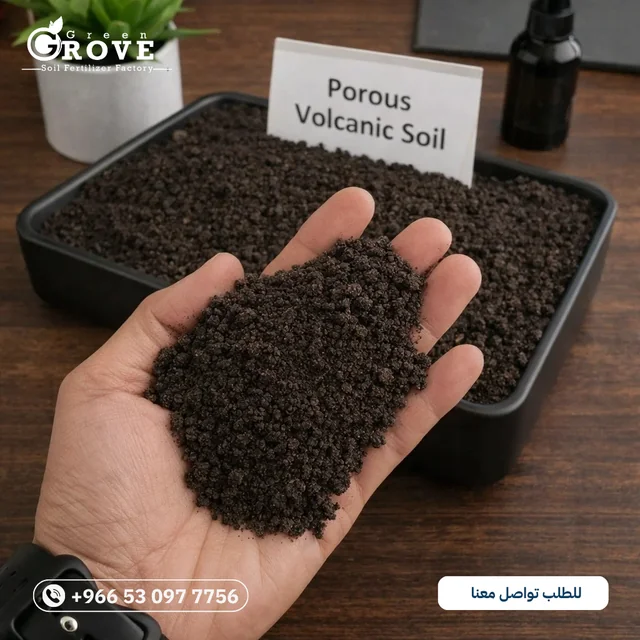
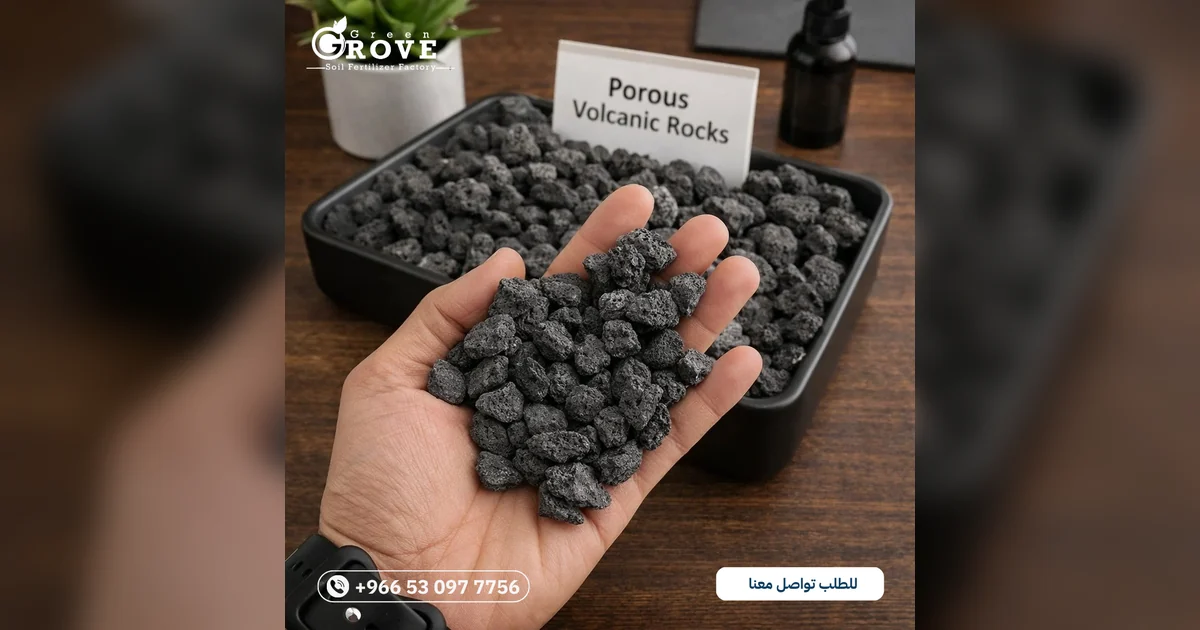
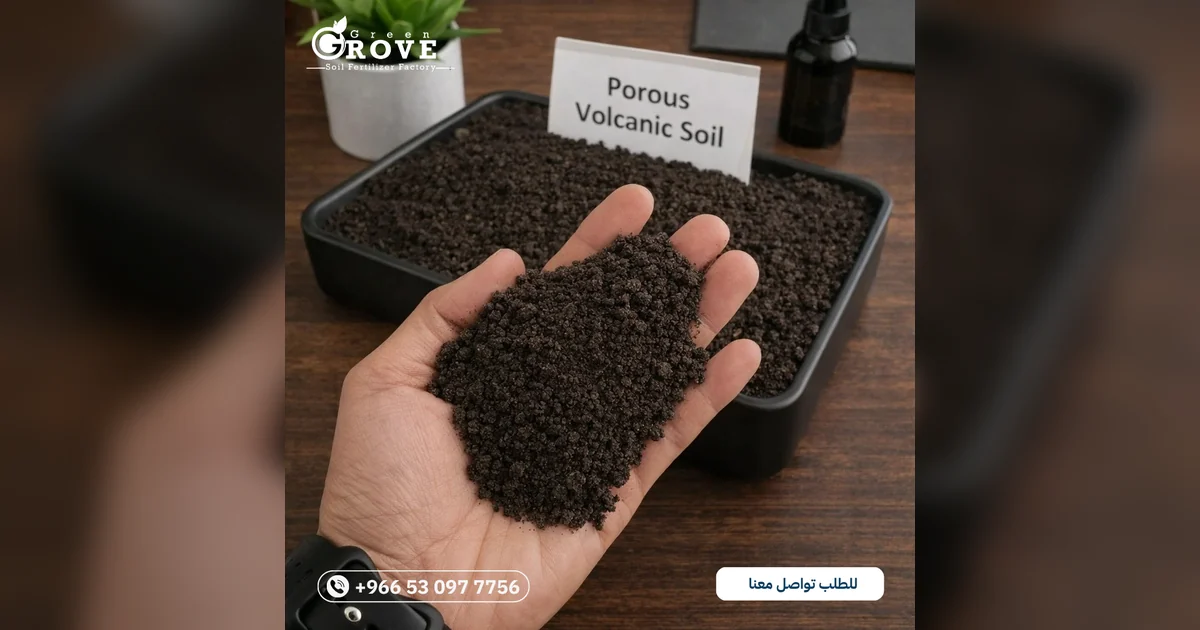
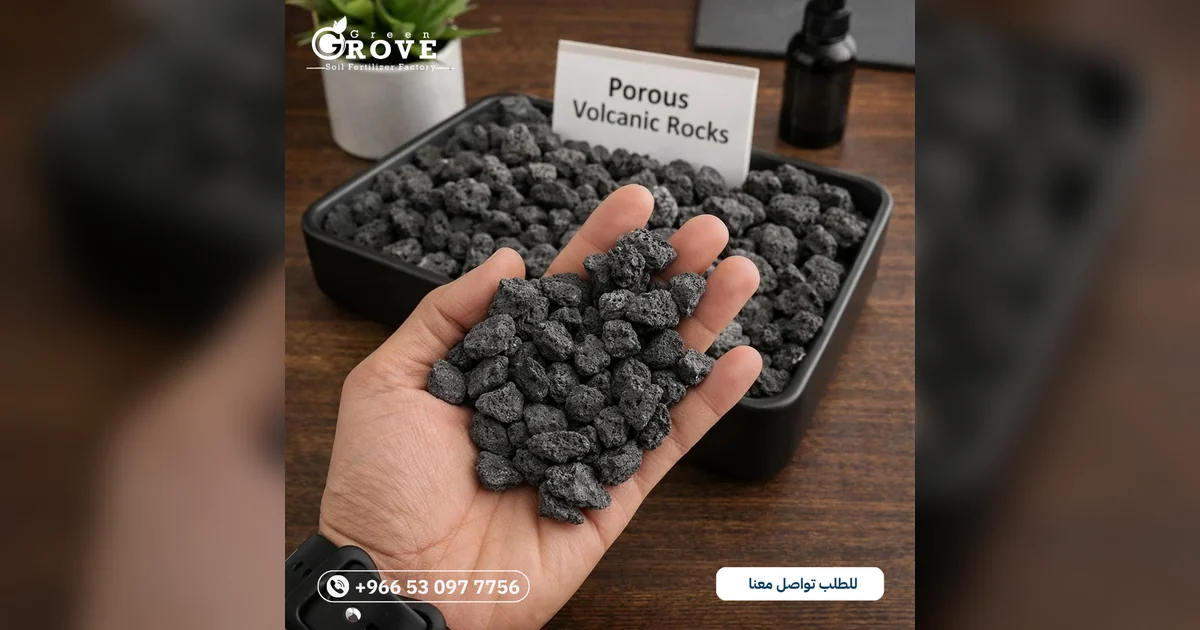
Agricultural volcanic stone is a porous granular mineral component that can be added to soil or growing media to modify physical properties. It is not a fertilizer and does not replace organic matter or crop nutrition. Used at an appropriate size and proportion, it can help:
- Increase structural pore spaces and air movement.
- Support movement of excess water and reduce prolonged saturation.
- Reduce compaction in some fine-textured mixes.
- Increase structural stability because the mineral component does not decompose like organic ingredients.
- Add useful weight and stability compared with extremely light components.
- Provide different particle-size options for pots, beds, and project applications.
The source article discusses Green Grove Soil grades of 0–4 mm for incorporation into many growing-media blends and 10–25 mm for applications requiring larger particles. Grade selection should follow the crop, bed or container size, and irrigation method.
Is There One Mix for Every Plant?
No. A universal recipe is too simplistic. Organic and mineral proportions should change with species, climate, container size, irrigation frequency, and the behavior of the base ingredients. Use an initial trial formula and modify it after checking drainage and water retention. For commercial projects, a small-scale trial before approving the full volume is prudent.
Practical Mix Concepts by Application
Houseplants
- An organic component that provides moderate water retention.
- Mature compost where appropriate.
- Fine volcanic stone or another mineral component for structure and aeration.
- A container with effective drainage holes.
Cacti and Succulents
- A higher mineral fraction.
- Less moisture-retentive organic material than in mixes for moisture-loving plants.
- A volcanic-stone grade suitable for the particle structure required.
- Irrigation after an appropriate level of drying.
Trees and Planters
- Base soil appropriate to the site.
- A calculated amount of organic material.
- Mineral structural components where the root zone needs better physical properties.
- Assessment of planter slope and drainage before filling.
Seedlings
- A light, uniform medium.
- Small particles that do not obstruct fine roots.
- Good drainage with moderate moisture retention.
- Clean components and a controlled nutrition program.